



Advanced Strategies for WooCommerce Attributes: SEO, User Experience, and Conversion Optimization with Dokan Conditional Category Attributes
Table of Contents
-
Introduction: Beyond Basic Configuration
-
SEO Architecture for Attribute-Rich Marketplaces
-
User Experience and Conversion Rate Optimization
-
Performance Tuning at Scale
-
Enterprise Category Management Strategies
-
Integrating with Analytics and Business Intelligence
-
Multilingual and Multi-Regional Considerations
-
Security and Data Integrity
-
Custom Development and API Integration
-
Future-Proofing Your Marketplace
Beyond Basic Configuration
You’ve installed Dokan Conditional Category Attributes. You’ve configured your categories, trained your vendors, and your marketplace is running smoothly. But you’re not here to run a smooth marketplace—you’re here to build a dominant one. This guide is for marketplace operators who want to extract every ounce of competitive advantage from their attribute infrastructure.
The difference between a good marketplace and a great one isn’t just functionality; it’s strategic execution. How you structure your attributes affects your Google rankings. How you present them to customers affects your conversion rates. How you manage them at scale affects your operational costs. And how you integrate them with your broader tech stack affects your ability to compete with industry giants.
-
SEO architectures that turn your attribute data into search engine gold
-
Conversion psychology and how attribute presentation affects buying decisions
-
Performance optimization for marketplaces with 10,000+ products and 500+ categories
-
Enterprise workflows for managing attribute rules across multiple administrators
-
Integration strategies connecting your attribute system to analytics, CRM, and ERP platforms
-
International expansion techniques for multilingual and multi-currency marketplaces
Whether you’re running a niche boutique marketplace or aiming to become the next major e-commerce platform, these strategies will help you maximize your return on investment from Dokan Conditional Category Attributes.
SEO Architecture for Attribute-Rich Marketplaces
Search engine optimization for multi-vendor marketplaces is fundamentally different from optimizing a single-brand store. You don’t control all the content, you can’t ensure perfect keyword density across thousands of vendor listings, and you’re competing with both other marketplaces and individual vendor websites. Your structural advantage is data—and attributes are the most structured data you have.
The Semantic SEO Foundation
Google’s algorithms have evolved from keyword matching to semantic understanding. They don’t just look for words on a page; they look for entities, relationships, and structured meaning. Product attributes map perfectly to this semantic model.
When a vendor fills in “Material: 100% Organic Cotton,” Google understands:
-
Entity: Product (Schema.org/Product)
-
Property: Material (schema.org/material)
-
Value: Organic Cotton (linked to the entity “Organic Cotton”)
-
Relationship: This product is made of this material
This semantic richness helps Google match your products to queries like “eco-friendly cotton t-shirts” even if those exact words don’t appear in the product description.
Category Page SEO Optimization
Category pages are often the highest-traffic pages on a marketplace. A customer searching “wireless noise cancelling headphones” will likely land on your “Headphones” category page, not an individual product page. The plugin’s frontend filtering enhances these pages significantly.
URL Structure Best Practices:
-
Use descriptive URLs:
yoursite.com/product-category/electronics/audio/headphones/ -
Avoid parameter-heavy URLs for filtered states when possible
-
Implement canonical tags to prevent duplicate content issues when filters are applied
Meta Description Automation: For category pages, dynamically generate meta descriptions that mention the top attributes available for filtering:
-
“Shop wireless headphones with active noise cancellation, 30+ hour battery life, and Bluetooth 5.2 connectivity. Filter by brand, price, and features.”
This signals to Google that your category page is a comprehensive resource, not just a product list.
Attribute-Based Internal Linking
Create internal linking structures that boost SEO authority:
-
Attribute Archive Pages: If your theme supports it, create archive pages for popular attribute values. For example, a page listing all products with “Material: Organic Cotton” across all clothing categories. This creates powerful thematic clusters that signal topical authority to Google.
-
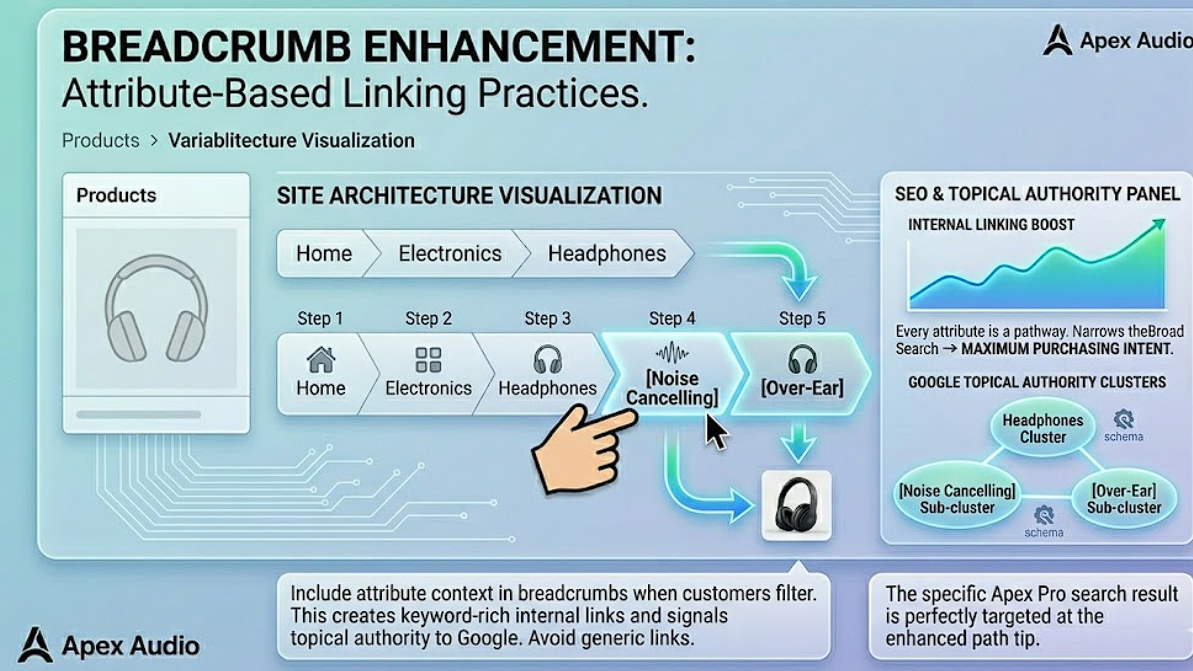
Breadcrumb Enhancement: Include attribute context in breadcrumbs when customers filter. Instead of just “Home > Electronics > Headphones,” show “Home > Electronics > Headphones > Noise Cancelling > Over-Ear.” This creates keyword-rich internal links and helps Google understand your site architecture.
-
Related Products by Attribute: Configure your related products algorithm to consider shared attributes. A customer viewing a “Cotton T-Shirt” should see related products that also have “Material: Cotton,” not just products in the same category. This creates attribute-based internal links that reinforce semantic relationships.
Long-Tail Keyword Domination
Long-tail keywords (specific, multi-word search phrases) convert 2.5x better than broad keywords and have 70% less competition. Your attribute system is a long-tail keyword generation engine.
Strategy:
-
Identify attribute combinations that represent high-intent searches
-
Create optimized landing pages or category filter states for these combinations
-
Ensure vendors fill in these attributes accurately
Examples of Long-Tail Opportunities:
-
“Men’s waterproof hiking boots size 11 wide” → Category: Men’s Shoes + Activity: Hiking + Feature: Waterproof + Size: 11 + Width: Wide
-
“16GB RAM laptop under 800 dollars lightweight” → Category: Laptops + RAM: 16GB + Weight: Under 2kg + Price Range: $600-$800
-
“Hypoallergenic organic cotton baby blanket blue” → Category: Baby Bedding + Material: Organic Cotton + Safety: Hypoallergenic + Color: Blue
Monitoring SEO Performance
Set up tracking to measure the SEO impact of your attribute strategy:
-
Google Search Console: Monitor impressions and clicks for category pages. Look for increases after implementing structured attribute filtering.
-
Rank Tracking: Use tools like SEMrush or Ahrefs to track rankings for attribute-specific keywords (e.g., “noise cancelling headphones 30 hour battery”).
-
Click-Through Rate (CTR): Compare CTR before and after implementing rich snippets. A well-structured attribute system should increase CTR by 15-30%.
-
Organic Traffic to Product Pages: Track whether product pages with complete attributes receive more organic traffic than sparse listings.
User Experience and Conversion Rate Optimization
SEO brings visitors to your marketplace. User experience (UX) and conversion rate optimization (CRO) turn those visitors into buyers. The conditional attribute system is a powerful UX tool when leveraged strategically.
The Psychology of Filtered Choice
Barry Schwartz’s “Paradox of Choice” demonstrates that too many options overwhelm customers and reduce conversions. When customers face 50+ filter options, many of which are irrelevant, they experience decision fatigue and abandon their search.
The plugin solves this by showing only relevant filters. But you can go further:
Progressive Disclosure: Don’t show all relevant filters at once. Show the 3-5 most important filters first, with an “Advanced Filters” toggle for the rest. For headphones, show “Price,” “Brand,” and “Noise Cancellation” prominently. Hide “Driver Size,” “Frequency Response,” and “Impedance” behind the advanced toggle unless the customer explicitly requests them.
Smart Filter Ordering: Order filters by customer importance, not alphabetically. For each category, analyze which filters customers use most (via analytics) and display those first. For smartphones, the order might be:
-
Price Range
-
Brand
-
Storage Capacity
-
RAM
-
Screen Size
-
Battery Life
-
Camera Resolution
-
Operating System
Visual Attribute Representation
Text-based filters are functional, but visual representations convert better:
Color Swatches: Instead of a dropdown or checkbox list for “Color,” show actual color swatches. When a customer sees a red circle, a blue square, and a black rectangle, they process the information 40% faster than reading text labels.
Icon-Based Filters: For boolean attributes, use icons:
-
“Waterproof” → Water droplet icon with a checkmark
-
“Wireless” → Wi-Fi signal icon
-
“Fast Charging” → Lightning bolt icon
-
“Organic” → Leaf icon
Range Sliders for Numerical Attributes: For “Battery Life,” “Price,” “Weight,” and “Screen Size,” use interactive range sliders instead of discrete checkboxes. Customers intuitively understand sliding a handle to set their minimum and maximum preferences.
Mobile Filter Optimization
Over 65% of e-commerce traffic comes from mobile devices. The filter experience on mobile must be flawless:
Bottom Sheet Pattern: Instead of a sidebar that pushes content or a dropdown that covers the screen, use a bottom sheet that slides up from the bottom of the screen. This is the native mobile pattern that users expect from apps like Amazon and Airbnb.
Sticky Filter Bar: Show a sticky bar at the top of the product grid with the number of active filters and a “Filter” button. When tapped, the bottom sheet opens. When filters are applied, the bar updates to show “3 Filters Applied” with a “Clear All” option.
Thumb-Friendly Touch Targets: Ensure filter checkboxes, swatches, and sliders have minimum 44px touch targets. Small touch targets frustrate mobile users and lead to accidental selections.
Attribute-Driven Product Recommendations
Transform your attribute system into a recommendation engine:
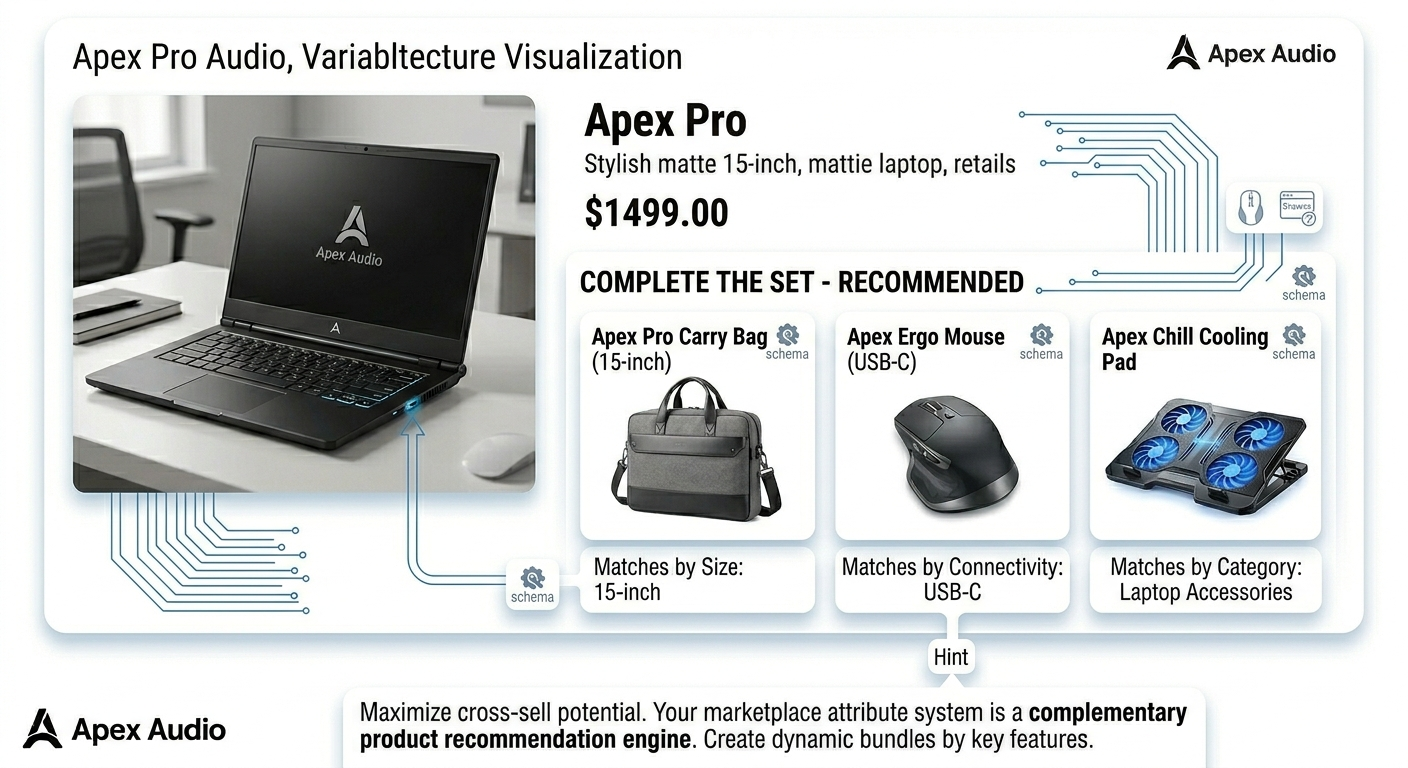
“Complete the Set” Recommendations: When a customer views a product, recommend products that share key attributes but serve complementary purposes:
-
Viewing a “Laptop with 16GB RAM” → Recommend “RAM Upgrade Kit” or “Laptop Bag for 15-inch screens”
-
Viewing a “Cotton Shirt Size M” → Recommend “Cotton Pants Size M” or “Cotton Jacket Size M”
Attribute-Based Bundling: Create dynamic bundles based on shared attributes:
-
“Complete Your Kitchen” bundle: All products with “Material: Stainless Steel” and “Category: Kitchen”
-
“Travel Essentials” bundle: All products with “Feature: Lightweight” and “Feature: Compact”
Reducing Returns Through Better Attribute Display
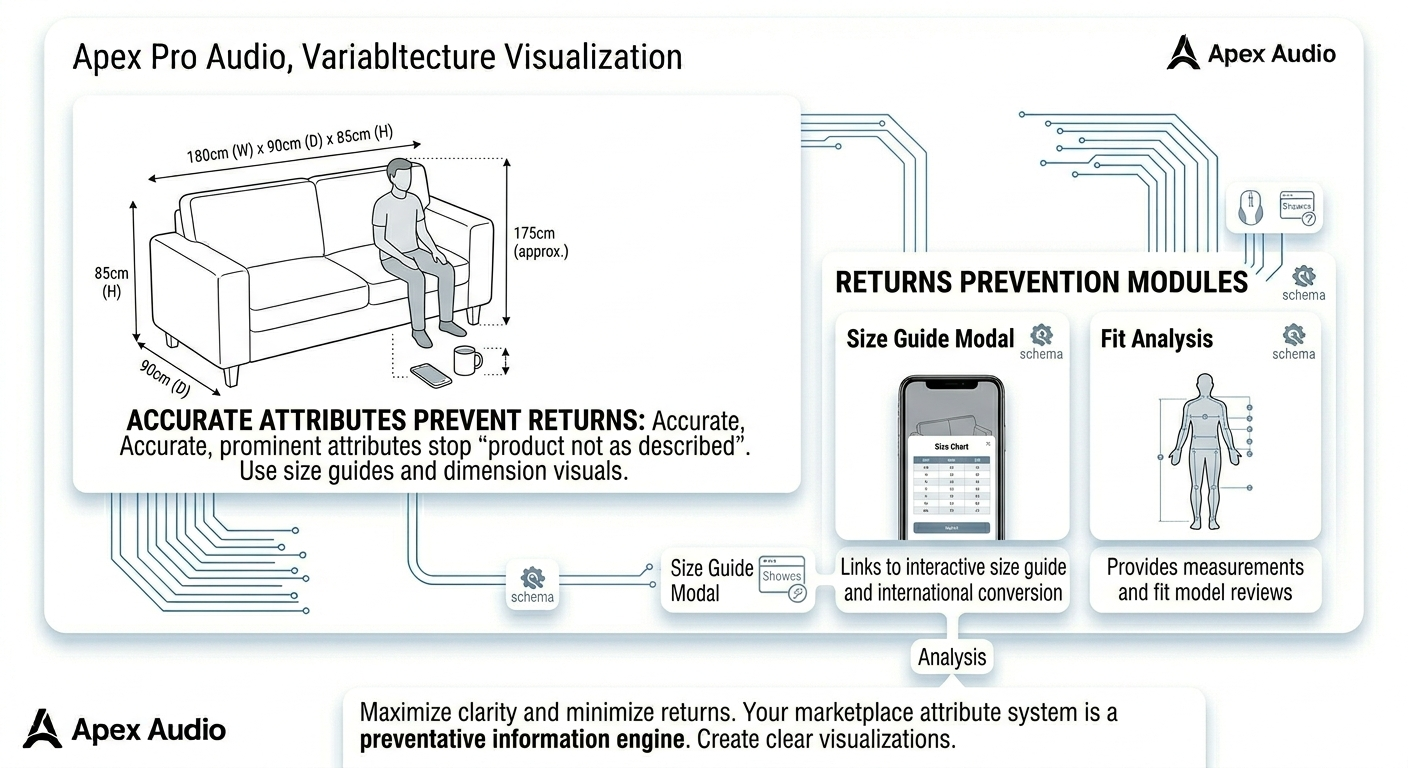
Returns destroy profitability. The leading cause of e-commerce returns is “product not as described.” Accurate, prominent attributes prevent this:
Size Guide Integration: For clothing and footwear, link every size attribute to an interactive size guide. When a customer sees “Size: M,” show a tooltip or link that opens a modal with measurements, fit models, and international size conversions.
Dimension Visualizations: For furniture and electronics, show dimensions in context. Instead of just listing “Dimensions: 60cm × 40cm × 30cm,” show a silhouette of the product next to a common reference object (a coffee mug, a smartphone, or a human figure for scale).
Compatibility Checkers: For accessories and parts, build compatibility checkers that use attributes:
-
“Will this phone case fit your phone?” → Customer selects their phone model; the system checks the “Compatibility” attribute
-
“Is this ink cartridge compatible with your printer?” → Customer enters printer model; system matches against “Compatible Models” attribute
Performance Tuning at Scale
As your marketplace grows to thousands of products and hundreds of categories, performance becomes critical. A slow category page kills conversions—every 100ms of delay reduces conversion rates by 1%.
Database Optimization
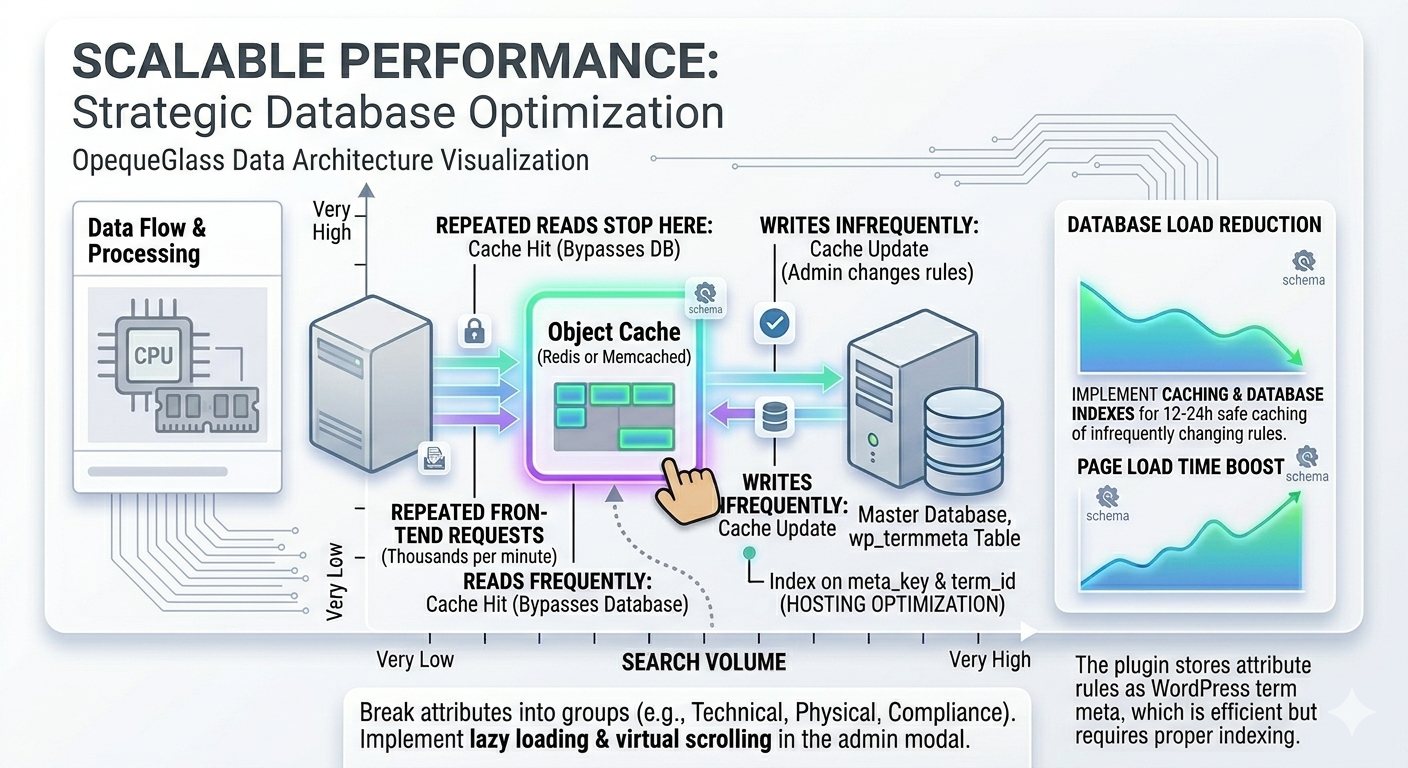
The plugin stores attribute rules as WordPress term meta, which is efficient, but at massive scale, you need to optimize:
Term Meta Indexing: Ensure your database has proper indexes on the
wp_termmeta table. If your hosting provider hasn’t optimized this, ask them to add an index on meta_key and term_id.Query Caching: The plugin’s frontend filter queries run on every category page load. Implement object caching (Redis or Memcached) to cache the results of attribute filter lookups. Since category rules change infrequently, you can cache these queries for 12-24 hours safely.
Attribute Lookup Optimization: For marketplaces with 500+ attributes, the admin modal can become slow. Consider:
-
Breaking attributes into groups (e.g., “Technical,” “Physical,” “Compliance”)
-
Implementing lazy loading in the modal so only visible tiles render initially
-
Using virtual scrolling for the attribute grid
Enterprise Category Management Strategies
Running a marketplace with 50+ categories and multiple administrators requires governance. Without rules and workflows, your attribute system will degrade into chaos.
The Attribute Governance Framework
Establish a governance document that defines:
Roles and Responsibilities:
-
Attribute Administrator: The person authorized to create, rename, or delete WooCommerce attributes
-
Category Manager: The person who assigns attributes to categories using the plugin
-
Vendor Success Manager: The person who trains vendors and audits listing quality
-
SEO Manager: The person who ensures attributes align with search strategy
Change Management Process: Before adding, removing, or renaming an attribute, require:
-
A business justification document
-
Impact analysis (how many existing products are affected?)
-
Vendor communication plan
-
Rollback plan in case of issues
Attribute Taxonomy Design
Design your attribute taxonomy with enterprise principles:
Controlled Vocabularies: Don’t let vendors create custom attributes for common specifications. If “Color” is a global attribute, ensure all color values are standardized (e.g., “Navy Blue” not “Dark Blue-ish” or “Almost Black Blue”). Use WooCommerce attribute terms to enforce this.
Attribute Groups: Organize attributes into logical groups for easier management:
-
Physical: Dimensions, Weight, Color, Material
-
Technical: Processor, RAM, Storage, Connectivity
-
Compliance: Certifications, Safety Ratings, Warranty
-
Commercial: MSRP, Release Date, Country of Origin
Naming Conventions: Establish strict naming rules:
-
Use Title Case for attribute labels: “Battery Life” not “battery life”
-
Include units in labels when ambiguous: “Battery Life (Hours)” not just “Battery Life”
-
Avoid abbreviations unless universally understood: “RAM” is fine; “FHD” might confuse some customers
Bulk Configuration Workflows
For initial setup or major restructuring, manually configuring each category is impractical. Develop bulk workflows:
Spreadsheet-Based Configuration: Create a master spreadsheet with columns for:
-
Category ID
-
Category Name
-
Parent Category
-
Allowed Attributes (comma-separated)
Use a custom script or WP All Import to bulk-update term meta based on this spreadsheet. This is significantly faster than clicking through each category in the admin.
Template Categories: Create “template” categories with perfect attribute configurations. When adding new categories, clone the template and make minor adjustments. This ensures consistency and reduces setup time.
Quarterly Audits: Schedule quarterly attribute audits:
-
Export all category configurations
-
Compare against current product catalog (are there new product types that need new attributes?)
-
Check for orphaned attributes (attributes assigned to categories with no active products)
-
Review vendor feedback for missing attribute requests
-
Update configurations and communicate changes
Integrating with Analytics and Business Intelligence
Your attribute system generates valuable business data. Integrating it with analytics platforms unlocks strategic insights.
Attribute-Based Sales Analytics
Configure your analytics platform (Google Analytics 4, Mixpanel, or Amplitude) to track attribute interactions:
Event Tracking:
-
filter_applied→ Track which attributes customers filter by most -
attribute_viewed→ Track which attributes customers expand or read -
product_comparison→ Track which attributes are compared most frequently
Dimension Segmentation: In your sales reports, segment by attribute values:
-
“Products with ‘Waterproof’ attribute convert 35% better than non-waterproof products in the same category”
-
“Customers who filter by ‘Organic’ spend 22% more per order”
-
“‘5G Support’ attribute increases average order value by $45 in the smartphone category”
Vendor Performance Scoring
Use attribute completeness as a quality metric in vendor performance dashboards:
The Attribute Quality Score (AQS): Calculate a score for each vendor based on:
-
Percentage of products with 100% of required attributes filled
-
Percentage of products with attribute images (for variation products)
-
Accuracy rate (how often attribute values match customer expectations, measured by returns and reviews)
-
Speed of attribute updates when category rules change
Display this score in the vendor dashboard and use it to determine search ranking boosts, featured placement eligibility, and commission rate negotiations.
Predictive Inventory Insights
Combine attribute data with sales velocity to predict inventory needs:
-
“Products with ‘Battery Life > 30 Hours’ sell 3x faster than those with ‘Battery Life < 20 Hours’ in the Headphones category”
-
“Blue and Black color variants represent 60% of all clothing sales—ensure vendors stock these colors first”
Share these insights with vendors to help them optimize their inventory and reduce stockouts.
Multilingual and Multi-Regional Considerations
Expanding into international markets requires adapting your attribute system for different languages, cultures, and regulatory environments.
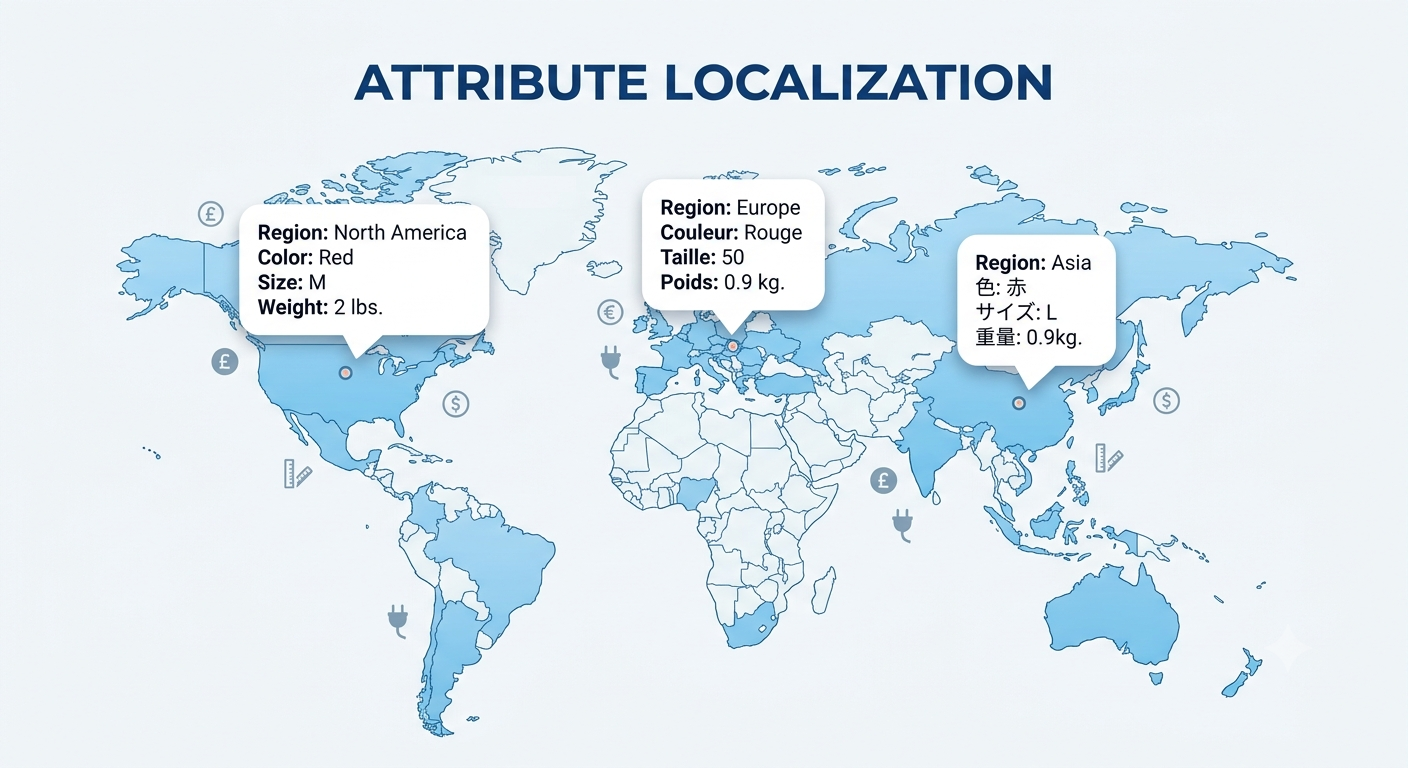
Attribute Localization
When using multilingual plugins like WPML, Polylang, or Weglot:
Label Translation: Translate attribute labels to match local conventions:
-
English: “Color”
-
Spanish: “Color” (same, but different pronunciation)
-
French: “Couleur”
-
German: “Farbe”
-
Japanese: “色” (Iro)
Value Localization: Some attribute values need cultural adaptation:
-
Clothing sizes: US “M” = UK “M” = EU “50” = Japan “L”
-
Voltage: “110V” for North America, “220-240V” for Europe
-
Measurements: Imperial (inches, pounds) vs. Metric (cm, kg)
Regulatory Attributes: Different regions require different compliance attributes:
-
EU: CE marking, GDPR compliance for electronics
-
US: FCC certification, Prop 65 warnings
-
UK: UKCA marking post-Brexit
-
Australia: RCM certification
Create region-specific attribute sets and use the conditional system to show only relevant compliance attributes based on the vendor’s shipping region or the customer’s location.
Currency and Pricing Attributes
If your marketplace supports multi-currency, ensure pricing-related attributes adapt:
-
“Price Range” filters should convert dynamically based on the customer’s selected currency
-
“MSRP” attributes should store the base currency and convert on display
-
Avoid hardcoding currency symbols in attribute values
Security and Data Integrity
Marketplaces handle sensitive vendor and customer data. Your attribute system must be secure and reliable.
Input Validation and Sanitization
The plugin handles sanitization automatically, but ensure your broader system follows best practices:
Vendor Input Validation:
-
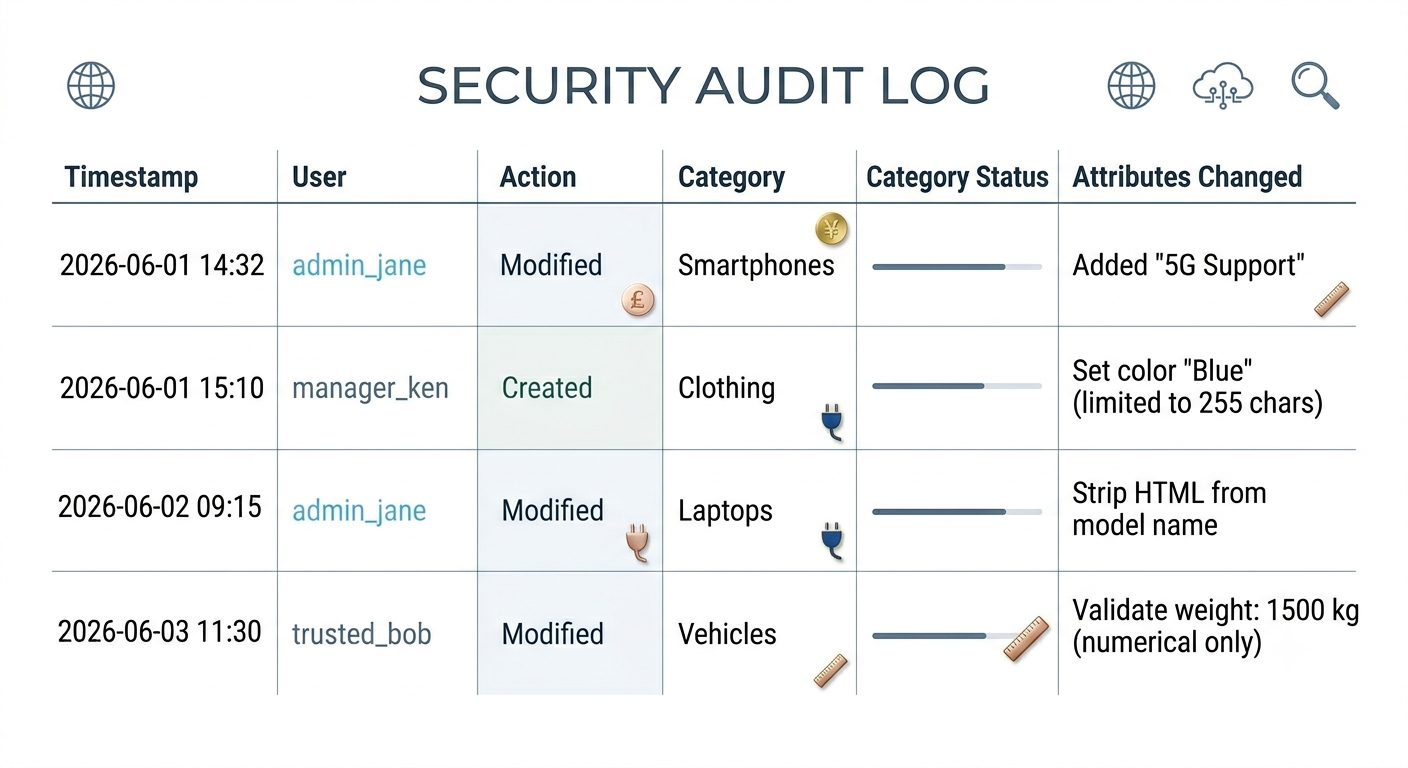
Limit attribute value lengths to prevent database bloat (e.g., max 255 characters)
-
Strip HTML tags from attribute values unless specifically required
-
Validate numerical attributes (e.g., “Weight” should only accept numbers and decimal points)
-
Use dropdown/select attributes instead of text fields for standardized values (e.g., “Color” should be a select, not free text)
Admin Security:
-
Only grant attribute configuration permissions to trusted administrators
-
Use role-based access control (RBAC) to ensure category managers can’t modify plugin settings or license information
-
Log all attribute rule changes with timestamps and user IDs for audit trails
Data Backup and Recovery
Since attribute rules are stored as term meta, they’re included in standard WordPress backups. However, for enterprise peace of mind:
Version Control for Rules: If you make frequent changes, maintain a spreadsheet or JSON export of your attribute rules. Before major changes, export the current state so you can restore quickly if something goes wrong.
Staging Environment Testing: Never test attribute configuration changes directly on production. Use a staging environment that mirrors your production database. The plugin’s license system supports staging domains—contact support if you need assistance with staging activation.
Conclusion: Building an Attribute-Driven Competitive Advantage
Dokan Conditional Category Attributes is more than a plugin—it’s an infrastructure investment that compounds in value over time. Every attribute you configure, every vendor you train, and every SEO enhancement you implement builds a moat around your marketplace that competitors without structured data cannot easily cross.
The strategies in this guide span from immediate tactical wins (better attribute labels, mobile filter optimization) to long-term strategic positioning (AI readiness, AR integration, ESG compliance). You don’t need to implement everything at once. Start with the fundamentals:
-
This Week: Audit your current attribute taxonomy and fix inconsistencies
-
This Month: Implement structured data markup and optimize your category page meta descriptions
-
This Quarter: Launch vendor training programs and establish attribute governance
-
This Year: Integrate analytics, explore AI-powered search, and prepare for international expansion
Your marketplace’s success depends on the quality of the shopping experience you deliver. When customers can find exactly what they want in three clicks, when vendors can list products in half the time, and when search engines understand your catalog with crystal clarity, you don’t just compete—you lead.
The attribute system is your foundation. Build it strong, manage it wisely, and let it power your marketplace to the next level.
Ready to implement these advanced strategies? Review your current setup against the benchmarks in this guide, prioritize your highest-impact opportunities, and start building the attribute-driven marketplace of the future today.

